
A mall retailer consumers describe as an “entry-level” luxury brand that features sophisticated, minimalist staples, has quietly closed five stores.
This year, a number of mall retailers have chosen not to renew their mall leases as they adapt to consumers’ shifting habits. The closures, however, come at a time when foot traffic across all three mall formats is growing year over year, according to recent data from Placer.ai.
Nonetheless, foot traffic and tenant occupancy vary widely by mall tiers, which is why a number of mall staples have been moving to open-air shopping centers. Others are heavily investing in their online presence, as consumers make more frequent but shorter and more mission-driven trips to malls.
Under my retail coverage for TheStreet, I recently reported on how Journeys’ parent company closed 25 stores last quarter to shift its footprint away from lower-traffic traditional malls and toward off-mall locations. Then, there’s Vera Bradley, which cut its traditional mall footprint by more than 43%.
Now, the parent company of a contemporary luxury brand Vince, popular for elevated, understated basics, such as cashmere sweaters, leather leggings, and silk blouses for “everyday effortless style,” is joining the group.
Vince quietly closes 5 stores in 12 months
For over two decades, Vince built its reputation as the holy grail for low-key quiet luxury before that was even a buzzword. The brand continues to draw shoppers interested in a minimalist wardrobe and timeless, high-end pieces without loud logos.
Vince Holding recently reported its second quarter of fiscal 2026 results. Total net sales were $81.8 million, up 11.7% compared to the same period in 2025.
Vince Holding Q2 fiscal 2026 earnings and operational highlights:
- Revenue growth: Total net sales increased to $81.8 million from $73.2 million in the prior-year quarter.
- Channel strength: Direct-to-consumer (DTC) sales rose 13.7%, while wholesale revenue increased 10.4%.
- Profitability surge: Adjusted EBITDA jumped to $18.0 million compared to $6.7 million in the same period last year.
- Strategic acquisition: The company acquired the operating business of OVO (the streetwear brand co-founded by Drake) to expand beyond the Vince brand and transition to a “multi-brand platform.”
- Store count: Ended the quarter with 53 company-operated Vince stores.
Vince Holding confirmed it has closed three full-price retail stores and two outlet locations over the last 12 months.
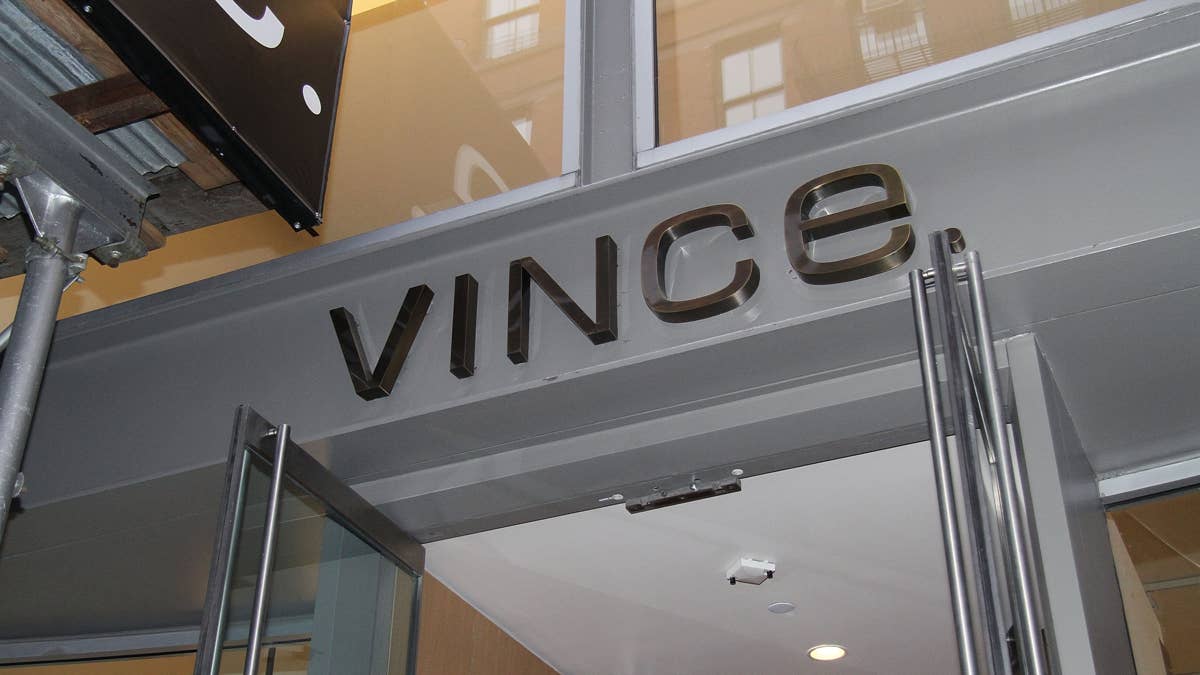
Why Vince’s store closures go far beyond these 5 locations
Vince Holding’s official reports reveal that the retailer has closed 16 net stores since reaching a post-pandemic peak of 68 locations in early 2022.
Shrinking from 68 stores (51 full-price, 18 outlets) down to 53 locations today (41 full-price, 12 outlets) represents a 22% reduction in its core brick-and-mortar footprint.
This confirms that the five store shutterings over the past 12 months are part of a deliberate multi-year strategy to trim excess real estate capacity, reduce fixed overhead, and lean into wholesale and direct-to-consumer e-commerce.
The management commentary suggests that right-sizing the store fleet has contributed to higher profitability. Instead of sales decline due to having fewer stores, the remaining fleet and e-commerce channels are operating highly efficiently.
“We delivered sales growth of nearly 12% with strength across both our direct-to-consumer and wholesale channels and delivered adjusted EBITDA of $18 million, including the benefits of tariff refunds,” Vince Holding CEO Brendan Hoffman said during the earnings call.
Retail expert and RTM Nexus CEO Dominick Miserandino agrees that the number of Vince store closures is less important than its sales growth with a reduced footprint.
“That means the remaining stores, e-commerce and wholesale are carrying more of the business. A smaller footprint can be a healthier footprint if you’re cutting locations that weren’t producing enough return,” Miserandino told TheStreet.
Vince Holding said profits more than doubled last quarter, but most of that gain came from a one-time $10.4 million tariff refund, not from the business actually improving as much, according to the company’s SEC filings. With that accounted, gross profit margin was really 48.2%, not the 60.9% the company highlighted.
The comparison is also distorted because last year’s quarter got its own one-time boost, a $5.6 million tax credit that lowered expenses, the SEC filing noted. Once both one-time boosts are removed, the underlying profit grew only slightly.
However, earlier this year, Vince reported a comparable direct-to-consumer sales surge of nearly 18% and continued double-digit growth last quarter, even after closing five stores.
Vince’s operating expenses also shrank as a percentage of total revenue last quarter, proving that closing unproductive stores helped management achieve “leverage of fixed costs on the higher sales.”
Vince doesn’t need discounts, despite consumers spending less on fashion
Vince’s earnings results confirm that demand for its offering is still there, even though a McKinsey analysis projected that the global fashion industry will once again post low single-digit growth in 2026.
Moreover, “growth in fashion and luxury retail is expected to remain low around the world as macroeconomic uncertainty persists,” McKinsey wrote in its November 2025 State of Fashion research.
Related: 44-year-old trendy clothing retailer closed 40 stores
Amid this lack of consumer willingness to spend on fashion, Vince’s latest results reveal that the brand is still managing to attract consumers.
“Highlights from the quarter include strong sales growth in both our women’s and men’s businesses, driven by full-price transactions across key categories, including woven tops, lightweight outerwear, and seasonal knits and sweaters,” Hoffman stated during the Q2 earnings call.
Vince management is pointing to full-price transactions, suggesting that they don’t need to discount products or rely on massive physical-store clearance sales to drive revenue. Closing underperforming stores allowed Vince to tighten inventory, protect its premium pricing, and increase sales to full-price buyers both online and in their surviving top-tier locations.
Vince is also leaning into its premier wholesale department store network, including department stores such as Nordstrom, Saks Fifth Avenue, and Bloomingdale’s, instead of carrying the capital risk of long-term real estate leases.
“Our summer and pre-fall collections resonated particularly well, and that momentum extended into the Nordstrom anniversary event. Underpinning it all is continued growth in our full-price customer base across all channels, which gives us confidence in the durability of the business,” Hoffman added.
What’s next for Vince? Building on Drake deal and creating a multi-brand platform
In late August 2026, Vince completed its acquisition of the operating business of OVO, the streetwear brand co-founded by Drake, in partnership with Authentic Brands Group (ABG).
Management plans to leverage Vince’s existing supply chain and department store relationships to scale OVO’s physical footprint and wholesale presence.
- Store openings: Vince plans to open about three U.S. OVO retail stores in fiscal 2027, while expanding the brand’s direct-to-consumer e-commerce platform.
- Wholesale rollout: Vince will launch OVO into U.S. wholesale department stores in the second half of fiscal 2027 using its existing relationships with luxury retailers.
- Revenue goals: Management expects OVO (which generated nearly $50 million in calendar 2025 sales) to remain earnings-neutral in fiscal 2026, become accretive in fiscal 2027, and scale significantly over the long term.
The acquisition gives Vince the operational setup to open physical Vince stores, wholesale accounts, and localized e-commerce in Canada.
“This transaction also deepens our relationship with Authentic Brands Group, a partner supporting our multi-brand platform strategy to broaden our portfolio of brands, business models, and distribution channels, and drive long-term value for all stakeholders,” stated Hoffman.
Related: After nearly 50 years, convenience store chain sells every location