
Americans have changed how they shop for groceries because of higher prices at the supermarket, along with rising gas prices and other climbing costs.
“Price pressure has fundamentally altered consumer behavior and eroded traditional brand loyalty. Instead of simply absorbing higher costs, shoppers are comparing stores, seeking promotions, and reconsidering purchases to stretch household budgets,” Iridio shared in August’s The 2026 State of Grocery + CPG Report.
Key findings include:
- 79% of adults spend additional time each week trying to save money on groceries compared to three years ago.
- 53% of consumers say concerns about costs have at least somewhat changed how they plan meals or manage grocery budgets.
- 42% of shoppers regularly visit multiple grocery stores to find the lowest prices.
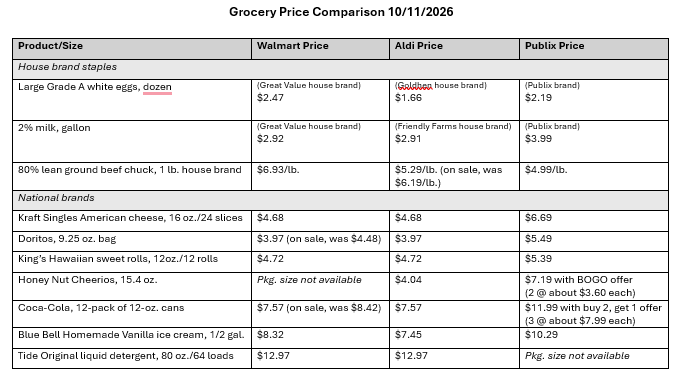
Finding the lowest price, however, can be a challenge. To help with that, TheStreet visited a South Florida Walmart Neighborhood Market, a Publix, and an Aldi. All the stores were within the same zip code in a mixed-income community.
In picking our basket, we went with household staples for which people often buy store brands, including a dozen eggs, a gallon of 2% milk, and one pound of ground beef.
To round out the cart, we added a number of items where consumers usually pick name brands, consisting of Kraft Singles, Doritos, King’s Hawaiian rolls, Coca-Cola, Blue Bell ice cream, and Tide detergent.
When pricing, we used any in-store sale price that did not require a physical or digital coupon, or a paid membership.
A look at Walmart, Aldi, and Publix pricing
Grocery stores, it should be noted, vary their pricing by location and adjust prices frequently. So, the prices here may not match those at your local stores, and some might have varied in the locations we visited, had we shopped on a different day.
“Price changes for food typically vary across regions based on consumer purchasing patterns, market shifts, and inflationary trends,” the USDA shared based on a 10-year look at prices around the country through 2024.
TheStreet
Here’s what we found
It appears that for national brands, Aldi and Walmart Neighborhood Market match each other’s prices on many items.
In most cases, each vendor selling to a chain sets two things:
- Manufacturer’s suggested retail price (MSRP): A brand recommends a price, but the grocery store generally decides what to charge.
- Minimum advertised price (MAP): A supplier may restrict how a retailer advertises a product’s price. That is different from restricting the actual checkout price.
- Source: Federal Trade Commission
Setting a minimum price is illegal in some states, but generally, if a retailer sells a product below a certain price, that means it’s discontinuing the item. Vendors do have the right to cancel contracts with retailers that don’t stay within their pricing guidance.
In addition, it turns out that shopping in different stores instead of buying everything at one chain would likely save you money.
All three retailers have items that are the most expensive on the list, and if you take advantage of the Publix buy-one-get-one offers, all three have items that are the cheapest.
Shutterstock
Consumers face a confusing grocery landscape
It makes little sense, given the value of your time and the cost of a gallon of gas, to go from Walmart Neighborhood Market to Aldi to save a single cent on a gallon of milk. The data above, however, does show that it might make sense to shop BOGO deals at Publix, and then go to either Aldi or Walmart Neighborhood Market.
Figuring out the best price on some items can be a challenge because stores offer different sizes. There’s a trick to that, according Edgar Dworsky, a consumer advocate in Boston who runs the nonprofit Consumer World website.
“I always say, check unit pricing for the best deal,” he said in an interview with Consumer Reports.
Not every state, however, requires unit pricing.
“It’s frustrating,” said Chuck Bell, Consumer Reports’ advocacy programs director. “If anything, we should be strengthening state and federal laws to make sure unit prices are routinely and consistently displayed throughout the country, including on e-commerce websites.”
Related: Walmart partners with Disney and M&M’s for an exclusive LTO candy