
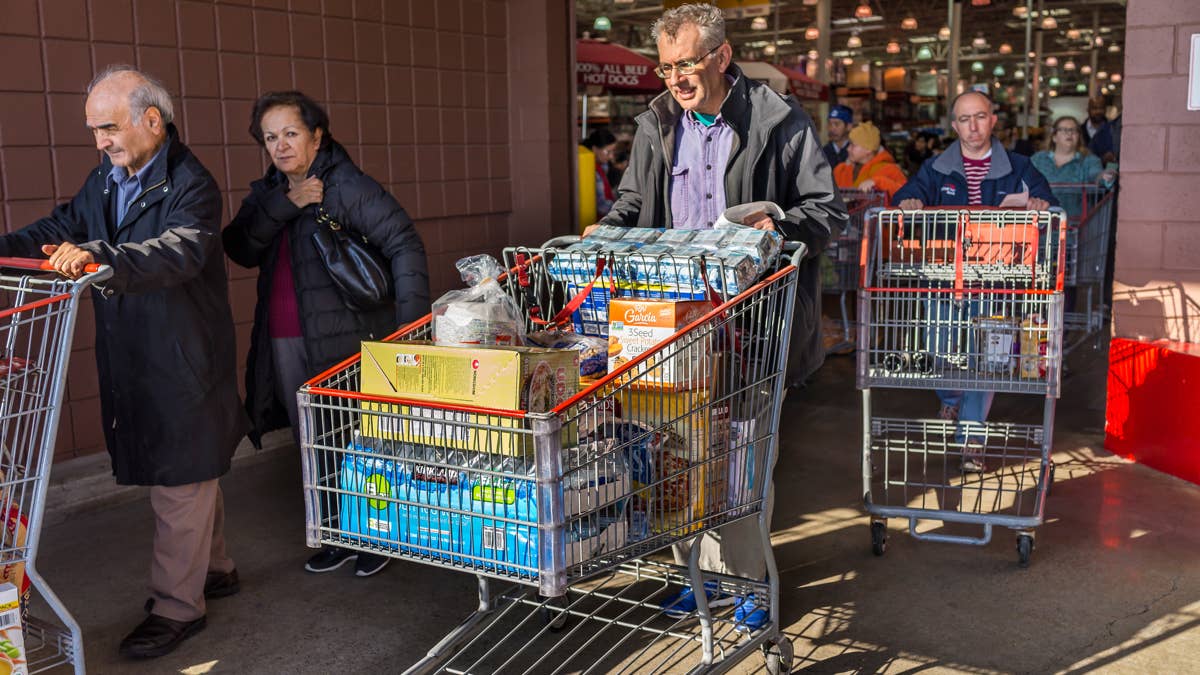
For decades, a Costco run has meant driving to the warehouse yourself, waiting in a long line at the door, and loading a flatbed cart built for hauling more than most people could carry alone.
That ritual sits at the center of Costco Wholesale’s (COST) business model, which is why the retailer has moved more cautiously into home delivery than rivals like Walmart and Kroger.
Costco’s model depends on getting shoppers into the store repeatedly, since frequent visits drive add-on purchases and reinforce the membership renewal habit that generates much of Costco’s profit.
A full embrace of delivery risked cannibalizing that foot traffic, which is likely why Costco kept its Uber Eats footprint limited to 17 states.
On Wednesday, Sept. 16, Costco and Uber Technologies (UBER) moved past that caution in a big way. The companies expanded their Uber Eats delivery partnership from 17 states to 47, according to a press release.
Nearly 600 Costco warehouses are now reachable through the app for on-demand or scheduled delivery, up sharply from before.
Members can now order fresh produce, bulk pantry staples, household items, and Kirkland Signature products without setting foot inside a warehouse. The service is also live on Uber Eats internationally, including in Canada, Mexico, Japan, Taiwan, France, and Spain, the companies said.
What’s actually new for Costco shoppers
To use the service, members open Uber Eats, select their nearest Costco, add items to a cart, and enter their membership number at checkout, per the press release.
Shoppers will be asked to verify their Costco membership before completing an order, though non-members can join through the app, CNBC reported.
The expansion comes with a stack of introductory perks:
- Eligible members get 50% off an annual Uber One membership the first year, then 20% after, according to the press release.
- For a limited time, $100 Uber and Uber Eats gift cards are selling for $79.99 at participating warehouses and on Costco.com.
- Buying a Costco membership through Uber Eats unlocks 30% off a shopper’s first qualifying order.
- Uber One members pay no Uber fees on eligible grocery and retail orders over $60.
Why Uber may have beaten DoorDash to Costco
The timing looks anything but accidental. Rumors of a DoorDash (DASH) deal with Costco surfaced Tuesday, sending shares of Instacart parent Maplebear (CART) down 5.4% against a 0.5% dip in the S&P 500, according to a Needham & Company note relayed by Investing.com.
Uber’s nationwide announcement landed the very next morning.
Needham’s analysts said the outcome barely changes Instacart’s exposure either way. The firm noted the competitive implications for Instacart “remain similar” whether Uber or DoorDash ultimately landed the wider Costco deal, since both threaten the retailer relationships Instacart has spent a decade building.
Related: Costco adds surprising seasonal item to lineup
The stakes look smaller for Uber’s own bottom line. The company’s Grocery & Retail segment has reached $15 billion in annualized gross bookings, growing more than 40% year over year, Needham said.
Costco joins other retailers Uber has added this year, including Stop & Shop, Food Lion, and Lowe’s. Even so, Needham called it unlikely that Costco alone will meaningfully move Uber’s consolidated results.
The relationship also has a history. Uber and Costco first tested delivery together in just 25 Texas warehouses back in 2021, a pilot that has scaled into nationwide coverage five years later.
What this means for Uber and Costco stock
For readers who don’t track the tickers closely: Uber runs the ride-hailing and delivery marketplace behind Uber Eats, while Costco operates the membership-only warehouse chain fulfilling the orders.
Neither stock is likely to move much on this news alone, but Wall Street is broadly bullish on both.
Analysts hold a Moderate Buy consensus on Uber, with 31 of 39 covering firms rating it a buy and an average price target near $105, according to MarketBeat.
More Retail:
- Costco sees major shift in member behavior
- Retail chain shuts all locations as legal changes hit industry
- Costco makes major investment in online shopping for members
Costco carries a similar Moderate Buy consensus, with most analysts rating it a buy and an average price target above $1,000, MarketBeat data show.
Shares of both companies traded modestly higher in premarket action on Sept. 16, suggesting the market is treating this as a customer-convenience story rather than a financial catalyst for either stock.
Uber’s stock has recently been driven more by its autonomous-vehicle bets than by delivery headlines, while Costco’s has tracked the pace of new warehouse openings and its historically high membership renewal rate.
The bigger shift in how America shops
Costco’s decision to lean into Uber Eats fits a pattern spreading across retail. Kroger expanded its DoorDash partnership this year.
Amazon has kept adding its own grocery partners. Even Walmart, long committed to building its own delivery fleet, has felt pressure to respond to what third-party apps are doing to price and speed expectations.
This is not new territory for Instacart. Shares fell last year when Amazon struck a similar delivery deal with grocery chain Winn-Dixie, part of a broader pattern of major retailers shifting business to rival platforms, according to Seeking Alpha.
What’s really shifting, this week’s headlines aside, is who controls the last mile to the American pantry.
Retailers used to treat delivery apps as a side experiment. Now securing the right partnership looks more like a competitive necessity, and the platform that locks in a retailer first, not necessarily the cheapest one, may end up owning that customer relationship for years.
For Instacart, the news carries a blunt reminder: Costco was never fully its own to keep.